|
By 1372, the construction of the donjon was completed and rising
about 50 metres above the ground of its courtyard this is now the highest remaining
construction of its type in Europe after the Coucy donjon was unfortunately destroyed in
1914.
The enceinte was also completed at around the same time but King Charles V decided to
extend the original project by ordering the construction of another vaster enceinte, which
was aimed at protecting the manor, the Saint-Martin Chapel and various other buildings.
The construction took place from 1373 through to 1380 and required approximately 260,000
limestone blocks just for the external facing wall.
From then the Vincennes castle remained virtually the same until King Louis XIV, who
wished to turn Vincennes into a grand palace residence, started an even more ambitious
phase of work in 1656.
The main entrance was changed and transformed into an arch of triumph. The Queen's
pavilion was built in perfect symmetry with the King's pavilion in the south-east corner
of the enceinte and built between the times of the construction of Chateau Vaux-le-Vicomte and Chateau de Versailles, the two pavilions of Chateau
de Vincennes define the classical style.
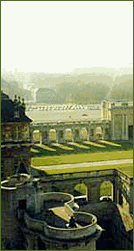
To the north of the pavilions, an arcade wall was built, which was to separate the royal
courtyard from the rest of the chateau.
Although the French King and his court often stayed at the Vincennes castle where there
were lots of hunting parties, performances and other festivities held, they decided to
move residences to the Chateau de Versailles in around 1671.
The Chateau de Vincennes is open from 10am until noon then from 1pm through to 6pm from
the start of May through to the end of August. From the start of September through
to the end of April this fabulous castle is open from 10am until noon, then from 1pm
through to 5pm.
However it is closed on all national holidays and the new rates for 2010 are €8 for
adults and €5 for concessions, but people under the age of 18 are allowed in free if
accompanied by an adult.
We would also like to point out the Chateau de Vincennes is only partially accessible to
those with reduced mobility.
Address & Contact Details:
Chateau de Vincennes
Avenue de Paris
94300
Vincennes
France
Telephone: 1 48 08 31 20
Fax: 1 58 64 23 95
|
|