|
There are audio guides available from reception that last 35
minutes and describe the spiritual message of this great cathedral through its history,
architecture, sculptures, windows, organs
and more. These are available in lots of different languages including French,
English, Japanese, German, Italian, Spanish, etc on a Monday to Saturday from 9.30am
through to 6pm and on Sundays from 1pm through to 6pm.
You can also have a guided visit, which is organised by the cathedral staff itself and
these are conducted in different languages on different days. For instance English
guided tours are provided on Wednesday at 2pm, Thursday at 2pm and a Saturday at 2.30pm,
whereas Japanese guided tours are held on a Friday at 2pm except for the first Friday of
the month and every Friday during Lent.
And there are tours in other languages such as Spanish, Russian, Portuguese, etc that are
held at different times, however any guided tours can be cancelled if there is a special
occasion, such as when the Requiem Mass of Jean-Marie Cardinal Lustiger, archbishop
emeritus of Paris, was held in the August of 2007.
There is also a religious article boutique located on the side of the nave, which is open
every day from 9.30am through to 6.30pm that has numerous items you can purchase such as
postcards, medals, charm necklaces, books, rosaries, and much more.
However, you can learn even more about the history
of Notre Dame with a visit to the Musee de
Notre Dame de Paris which is located only a very short walk away from the cathedral.
Mass and Services
To attend services that are open to all, you would need to take any seat a few minutes
before the service, either in the nave, or in the choir for 8am and 9am masses during the
week, but you should be seated around ten to fifteen minutes before the Sunday or holiday
services are due to start.
On a Sunday all of the services are held at the main
altar and are as follows:
8.30am - mass
9.30am - lauds service
10am - gregorian mass at the cathedral chapter
11.30am - international mass
12.45pm - mass
5.45pm - vespers service
6.30pm - mass which is usually conducted by the archbishop and often broadcast
live.
On weekdays they do differ slightly as follows:
8am - mass in the choir
9am - mass in the choir
noon - mass at the main altar
5.45pm - vespers service that is broadcast live on KTO-Catholic Television
6.15pm - mass at the main altar
But please not that during the months of July and August there not a mass at 9am on a
Monday to Saturday.
Tower Visit
The Notre Dame Cathedral tower visit is unfortunately not accessible for the disabled as
there is no lift, but for those fit enough to climb the 402 steps experiencing the upper
parts of the western facade that date from the 13th century is an unforgettable
experience, although there is a small fee payable to do this.
You can go up the bell tower and see the magnificent bell that was saved from being melted
down and incredibly it used to take over twenty people to ring the bell due to its sheer
size and weight, but today this is done electronically and only sounds for Sunday Mass and
on special occasions.
Another major plus to climbing the spiral staircase of the bell tower to the belfry are
the fantastic up close views of the gargoyles and chimera that you cannot see very well
from ground level and you can see the flying buttress architecture, plus you can venture
even higher than the tower where you have a fantastic view of Paris, especially at night
with the city all lit up.
You can gain access to what are known as the North tower upper room, Great Gallery, belfry
and South tower terrace for what can only be described as an unforgettable experience.
The entrance for the visit of the tower is located on the outside of the cathedral and as
you look at the entrance it is on the left-hand side of the facade, on Rue du Cloître
Notre-Dame.
The tower visit is open every day except for 25th December, the 1st January and the 1st
May with the last access being 45 minutes prior to closing. From April until
September it is open from 10am through to 6.30pm, yet in June, July and August on a
Saturday and Sunday it is open from 10am through to 11pm. But from October until the
end of March it is open from 10am through to 5.30pm.
The new costs as of 2010 for adults is €8 and concessions are 5€. However
those under the age of 18 are free if accompanied by an adult.
The Square
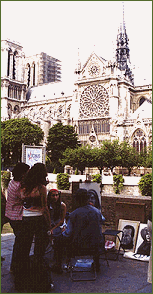
The square in front of the Notre Dame Cathedral became a focal centre of the French
resistance against the Nazi occupation and here they withstood a German seige with tanks
and guns for four days and if you look carefully at the walls of the square, you will find
plaques commemorating the brave Resistance fighters during World War II.
Also, in the square at the front of Notre Dame is a plaque that was put in place by André
Michelin, who was the founder of the Michelin tyre business and it is from this point that
all distances in France are measured as this is classed as point zero.
So whether you are visiting the Notre Dame de Paris on
a pilgrimage or just as a tourist, this is a fascinating building, which has become one of
the very famous landmarks in Paris and is not to be
missed on your holiday to France and Paris.
Address & Contact Details:
Cathédrale Notre-Dame de Paris
Rue du Cloître Notre-Dame
75004
Paris
France
Telephone: 1 53 10 07 00
Fax: 1 53 10 17 06
|
|